
Last updated October 30, 2026
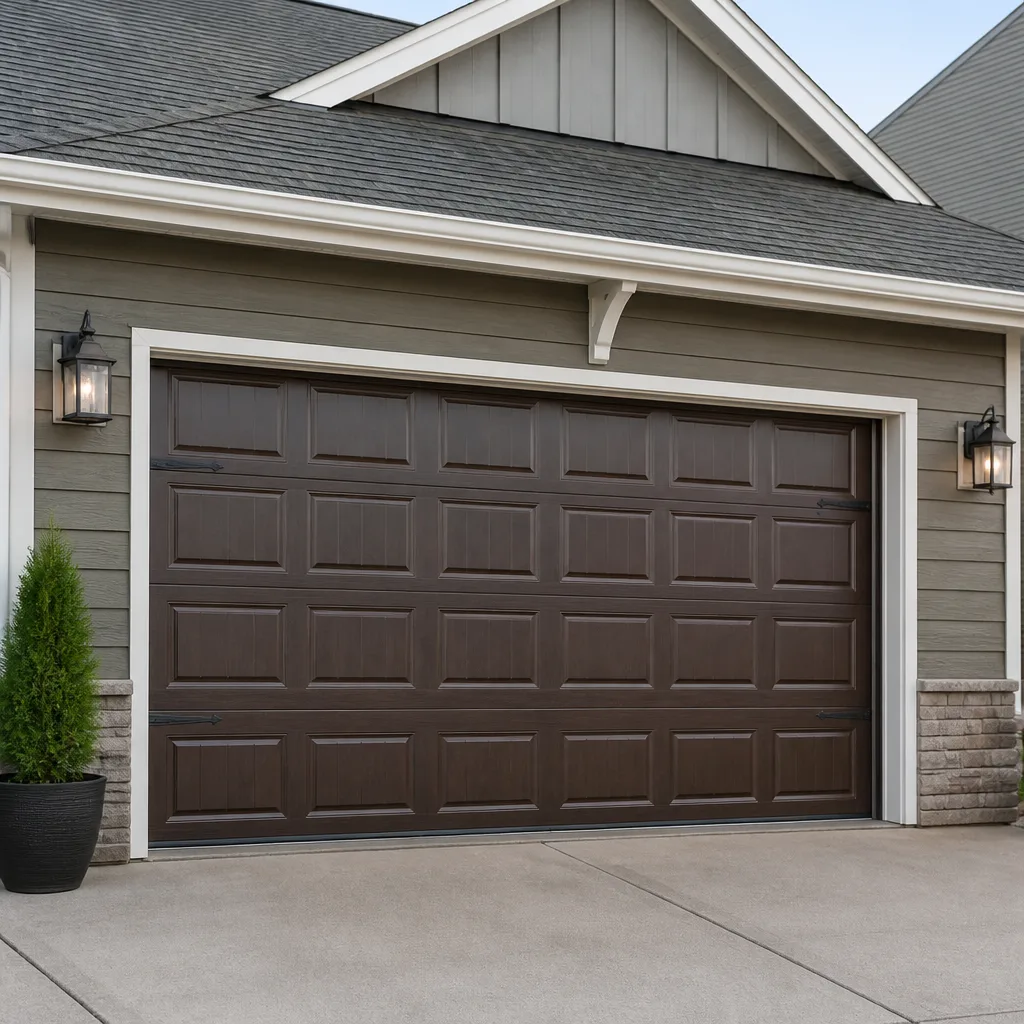 Raised-panel steel
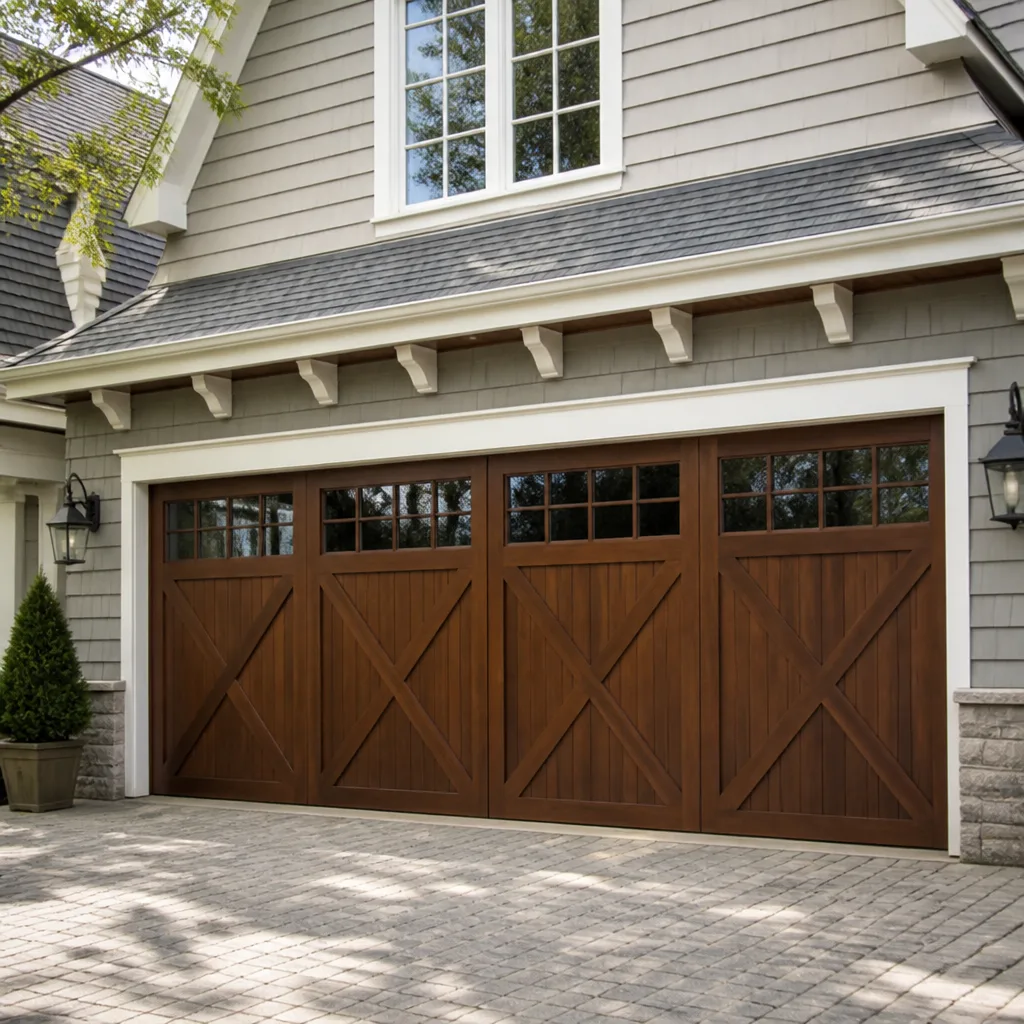 Carriage house
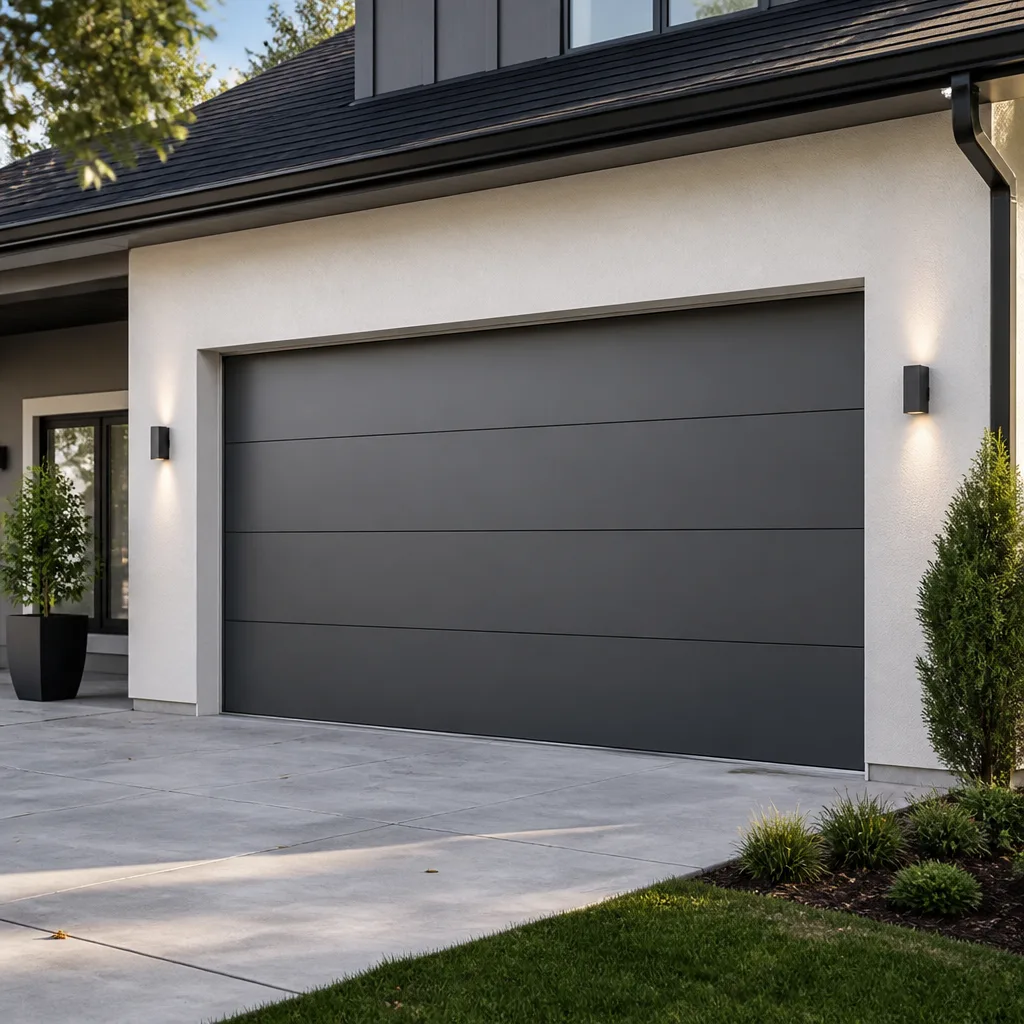 Modern flush
 Full-view glass
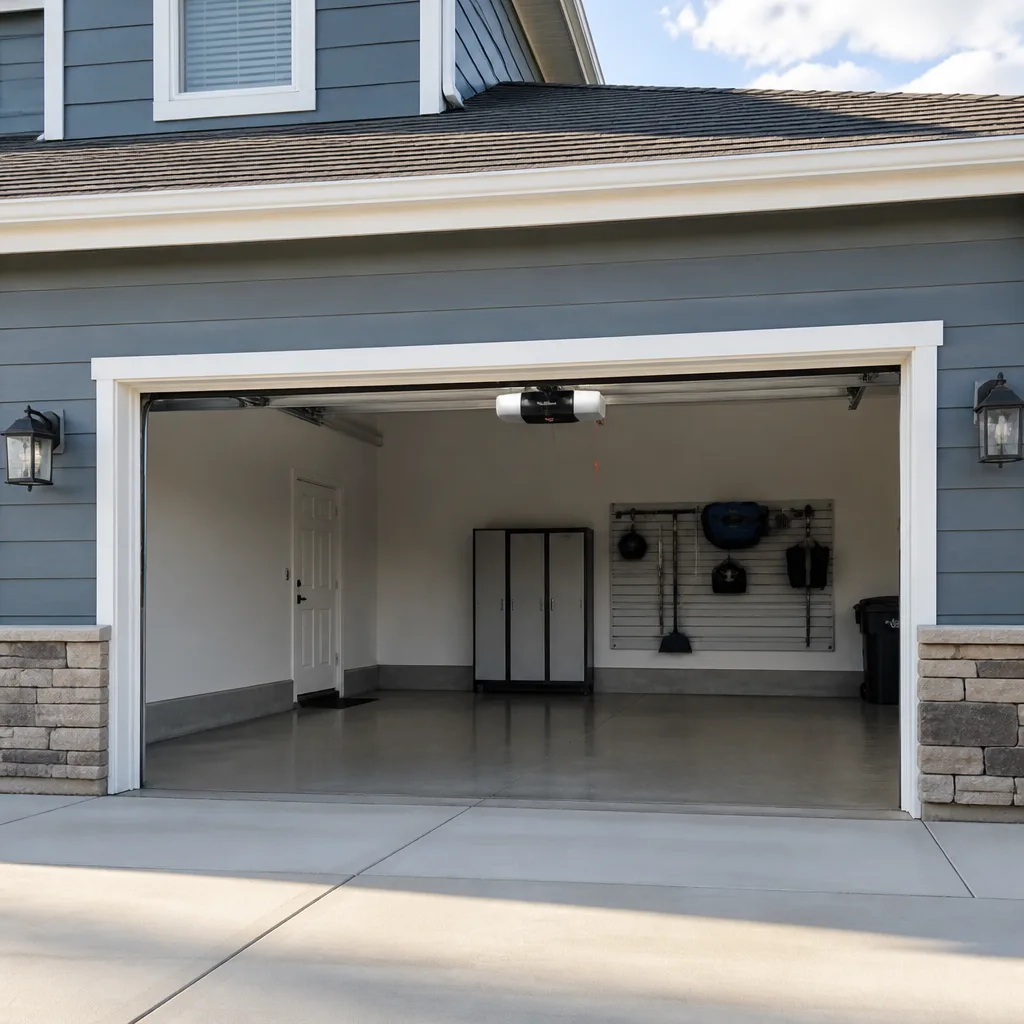 LiftMaster openers
 Chamberlain openers
Full 25-point door and opener safety check with every visit - springs, cables, rollers, tracks, and your LiftMaster or Chamberlain opener included
You get a price before we start. It does not change when the truck arrives.
Get your free estimateGarage Door Repair Maintenance Checklist for Miami Beach Homeowners
Most garage door maintenance guides read like they were written for someone in Ohio. Mild summers, dry winters, the occasional rainy week. That advice falls apart fast when you live three blocks from the Atlantic. The number-one reason Miami Beach garage doors fail prematurely isn’t age, and it isn’t poor installation. It’s maintenance routines copied from national guides that were never designed for a coastal subtropical environment. Salt air corrodes hardware twice as fast here as it does inland. Humidity swells wood doors and rusts steel ones. Hurricanes test your door’s structural hardware in ways no northern winter ever will. This guide replaces the generic checklist with a Miami Beach-specific protocol: what to inspect monthly, what to do before hurricane season, and which maintenance habits actually matter when your door lives in salt, heat, and humidity year-round. For professional help, see our Garage Door Repair services.
Quick Answer
A Miami Beach garage door maintenance routine needs monthly salt-air corrosion checks on springs, cables, hinges, and tracks; lubricant chosen for high-humidity climates; quarterly cleaning of all moving parts; and a pre-hurricane-season inspection that tests seal integrity, manual release, and wind-load hardware. Tasks that national guides suggest doing annually, like hinge lubrication and track cleaning, need to happen every three to four months in Miami Beach’s coastal environment.
Styles & brands we work with
Table of Contents
- The Salt-Air Corrosion Inspection: What to Look For Every Month
- Lubricant Selection in a High-Humidity Climate: What Works and What Makes Things Worse
- The Pre-Hurricane-Season Checklist: Beyond Testing the Door
- Wood, Steel, or Aluminum: Material-Specific Maintenance for Miami’s Humidity
- Frequency Adjustments: What Needs to Happen Twice as Often Here
- What You Can Safely Do Yourself (And What You Shouldn’t)
- Common Mistakes to Avoid
- When to Call a Professional
- Frequently Asked Questions
The Salt-Air Corrosion Inspection: What to Look For Every Month
Salt air is relentless. It doesn’t just sit on metal surfaces; it works its way into hinges, wraps around cable strands, and eats at spring coils. The monthly inspection is the single most important maintenance habit for any garage door repair in Miami Beach, because catching corrosion early is the difference between a $200 hinge replacement and a snapped cable that takes the door off its tracks.
The Monthly Salt-Air Inspection Routine
Set aside ten minutes once a month. Here’s exactly what to look for, in order of how likely it is to fail in coastal air:
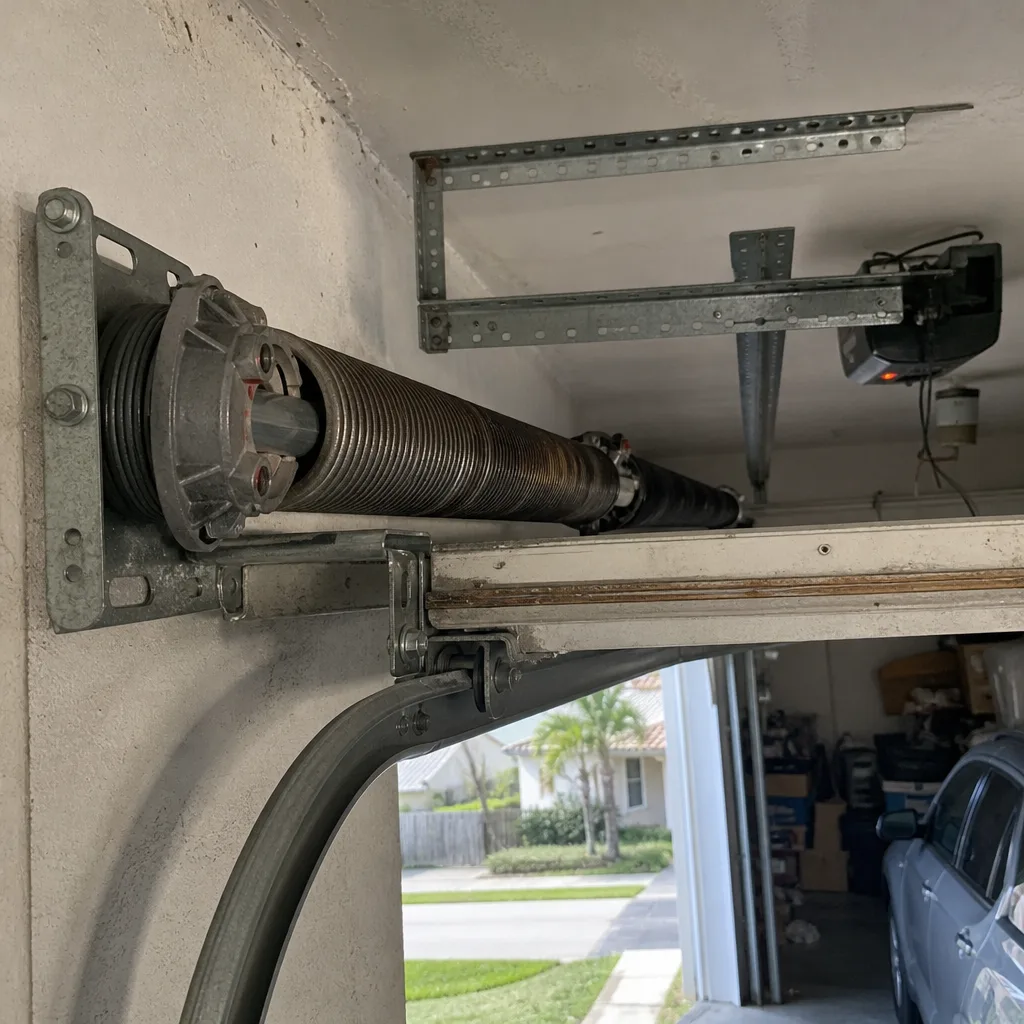
- Springs (torsion or extension): Look at the coils. Light surface rust isn’t a problem by itself, but orange-red flaking, pitting, or any visible gap in a torsion spring coil means the spring is fatigued and close to breaking. A torsion spring under tension that breaks is dangerous, which is why this is a visual check, not a touch test.
- Cables: Run your eyes along the full length of each cable. In Miami Beach, cables fail from the inside out. Look for any strand that’s frayed, any spot where the cable looks fuzzy or lighter in color, or rust-colored dust around the cable drum. That dust is the metal breaking down.
- Hinges and rollers: Hinges should move freely. If you see white, chalky residue on steel hinges, that’s zinc corrosion, a sign the protective coating is gone. Rollers should sit squarely in the track without wobble. Worn rollers put lateral strain on hinges, which accelerates wear in humid air.
- Bottom brackets: These connect the cables to the bottom of the door. They hold tension constantly and take the brunt of salt spray from driveway flooding and storm surge. Look for bubbling paint, flaking metal, or any visible crack at the bend point.
- Track alignment: Run the door up and down slowly while watching the track. If you hear grinding or see the door shimmy side to side, the track has shifted, likely from heat expansion and contraction combined with loosened bolts.
In our experience, we see a pattern on Miami Beach service calls: the homeowner noticed a noise or a rough spot weeks before the failure, but didn’t know it was a warning sign. See our guide to Garage Door Warning Signs: A Miami Beach Homeowner’s Reference Guide to learn what to watch for. If anything on this list looks off, even if the door still opens and closes, that’s the time to have it looked at, not after it breaks.
Lubricant Selection in a High-Humidity Climate: What Works and What Makes Things Worse
Here’s a problem the national maintenance guides never address: in Miami Beach’s humidity, the wrong lubricant actually attracts moisture and accelerates rust. A petroleum-based spray designed for dry climates will work fine in Arizona. In Miami, it creates a sticky film that holds salt particles against the metal. The result is the opposite of protection.
Lubricants That Work in Coastal Humidity
- White lithium grease: Good for hinges and door tracks. It repels water well and stays in place. Apply sparingly, once every three months in Miami Beach.
- Dry PTFE (Teflon-based) spray: Excellent for rollers and springs because it doesn’t leave a residue that traps salt. It costs more, but it’s worth it for coastal homes.
- Marine-grade silicone spray: Designed for saltwater environments, lasts about twice as long as standard silicone. Use on the weather seal and any rubber or vinyl components to keep them pliable.
Lubricants to Avoid Near the Ocean
- WD-40 (standard formula): It’s a solvent and rust dissolver, not a lubricant. It strips away any remaining protective coating and then evaporates, leaving bare metal more exposed than before.
- Heavy axle grease: Traps salt and sand. After a few months in Miami Beach, it turns into an abrasive paste.
- Whatever is already in the garage: Motor oil, cooking spray, general household oils. All of them attract dust and salt. None of them protect in a coastal environment.
Beyond product choice, frequency matters. A homeowner in Minneapolis can lubricate hinges once a year and be fine. In Miami Beach, the combination of heat breaking down lubricant and salt air getting underneath it means every three months is the realistic interval. This applies to doors from any manufacturer, whether you have a Raynor, Clopay, Amarr, or any other major brand: the hardware is metal, the air is salty, and the chemistry doesn’t change.
We work on the brand you already have, and the lubricant recommendation is the same across all of them: water-repellent, non-sticky, re-applied quarterly.
The Pre-Hurricane-Season Checklist: Beyond Testing the Door
Every June, Miami Beach homeowners do a hurricane readiness pass on their shutters, their generator, their emergency supplies. The garage door gets a quick open-and-close test, if that. But the garage door is the single largest opening in the house, and if it fails during a storm, the pressure differential can lift the roof. A simple functional test doesn’t tell you what you need to know.
The Six-Step Hurricane-Season Garage Door Inspection
- Bottom seal integrity: The rubber strip along the bottom of the door keeps wind-driven rain and storm surge out. In Miami Beach, it degrades faster than inland because of UV exposure and salt. Look for cracks, flattening, or gaps where it meets the floor. If you can see daylight under any section of the closed door, the seal needs replacing.
- Manual release function: Pull the red emergency release cord. The door should lift manually with reasonable effort. If it’s heavy or sticks, the springs are out of balance, and a power outage during a storm means you’re not moving that door by hand.
- Wind-load hardware check: Doors rated for Miami-Dade County’s wind codes have reinforced struts, heavier track brackets, and stronger hinges than standard doors. Visually confirm that no strut has come loose and that all bracket bolts are tight. If your door predates the current building code, and you don’t know whether it’s wind-rated, this is a good time to find out.
- Track bolts and anchor plates: Tracks take the lateral wind pressure in a storm. Loose bolts here mean the door panel can flex out of the track during heavy gusts. A wrench check on all track bolts takes five minutes.
- Spring tension: Disconnect the opener and lift the door halfway. It should stay in place. If it drops, one or both springs is weak, and the door will be heavier than it should be, straining the opener motor and making manual operation nearly impossible when you need it most.
- Opener battery backup: If your opener has a battery backup unit, test it. Run the door three full cycles on battery power. Most battery failures are found after the power is already out, which defeats the purpose.
This six-step pass takes about thirty minutes and should happen every May, before the season ramps up. For Chamberlain and LiftMaster openers specifically, the battery backup test is a menu option on the wall console; older Genie and Craftsman units may not have one at all. Knowing which equipment you have before the storm is part of the checklist.
Wood, Steel, or Aluminum: Material-Specific Maintenance for Miami’s Humidity
The most common maintenance mistake in Miami Beach is treating every garage door the same regardless of what it’s made of. Wood, steel, and aluminum all fail differently in this climate, and each needs a different routine.
Wood Doors: The High-Maintenance Reality
Wood garage doors are beautiful, and they’re also the most labor-intensive option for a coastal setting. Miami Beach humidity makes unfinished wood swell, which means the door panel itself can gain weight and change shape over the course of a single summer. A wood door that fit perfectly in January can scrape the track in August.
- Seal every exposed surface annually: Top, bottom, edges, and especially the bottom panel that sits closest to the ground. An unsealed bottom edge absorbs standing water from afternoon storms.
- Check for delamination: Press on the panels. If the wood moves or feels spongy, moisture has worked into the layers. Caught early, it can be sanded and resealed. Missed for a season, the panel usually needs replacement.
- Expect the door to change with the seasons: Adjust the track spacing if the door starts binding. This isn’t a defect; it’s normal for wood in this climate.
Steel Doors: Corrosion, Not Just Surface Rust
Steel garage doors dominate the Miami Beach market because they’re affordable and wind-rated options exist across every price point. But salt air is brutal on steel, especially at the bottom edge and anywhere the paint is scratched.
- Touch up paint immediately: Any scratch that reaches bare metal becomes a rust point within weeks near the ocean. Keep a matching touch-up paint on hand.
- Inspect the bottom panel monthly: This is where salt spray and standing water accumulate. Look for bubbling under the paint, rust streaks, or pinhole-sized rust spots. Once rust penetrates the panel, it compromises the door’s structural rating.
- Check the insulation backing: If your steel door has an insulated interior panel, moisture trapped between the steel and the insulation accelerates internal corrosion you can’t see until it’s severe.
Aluminum Doors: The Low-Corrosion, High-Flex Option
Aluminum doesn’t rust, which makes it a popular choice for beachfront and near-beach homes. But aluminum has its own failure mode in Miami Beach: it’s softer than steel and flexes more, especially with full-vision glass panels.
- Inspect frame joints and welds: Aluminum flexing in high winds can crack at the corners where panels meet. Look for hairline cracks around the frame and any loosening of the glass inserts.
- Check for galvanic corrosion: Where aluminum hardware meets steel fasteners or brackets, the two metals react in salt air. The aluminum corrodes sacrificially, leaving white powder around the contact point. Replace steel fasteners with stainless when found.
- Clean the tracks more frequently: Aluminum produces more fine dust as it wears than steel, which accumulates in the track and wears rollers faster.
Whether your door is a Wayne Dalton steel model, a Clopay aluminum full-view door, or anything else, the material dictates the routine. We service all of them, and the right maintenance protocol depends on what you actually have, not what a generic guide assumes.
Frequency Adjustments: What Needs to Happen Twice as Often Here
The national maintenance schedules published by manufacturers and DIY sites assume an average climate. Miami Beach is not an average climate. Here’s the honest adjustment schedule for coastal South Florida:
- Hinge and roller lubrication: National recommendation: annually. Miami Beach reality: every 90 days. Heat thins the lubricant quickly, and salt air is always working to get underneath it.
- Full hardware inspection: National recommendation: twice a year. Miami Beach reality: monthly, during hurricane season at minimum. Corrosion doesn’t follow a calendar.
- Track cleaning: National recommendation: rarely mentioned at all. Miami Beach reality: quarterly. Salt residue, sand from beach trips, and the fine dust from high humidity accumulate quickly.
- Bottom seal inspection: National recommendation: annually. Miami Beach reality: check it every time you wash the car or sweep the garage floor. It’s the first line of defense against storm water, and it fails silently.
- Spring inspection (visual): National recommendation: annually by a pro. Miami Beach reality: every month for the basic visual check, plus a professional tension test before hurricane season. Salt pitting on springs is a slow-motion failure that a monthly glance will catch.
- Balance test (the halfway lift): National recommendation: annually. Miami Beach reality: do it quarterly. A door that’s even slightly out of balance wears the opener motor, the hinges, and the cables faster, and that wear compounds in a humid, salty environment.
These adjustments aren’t optional extras. They’re the recognition that a garage door in Miami Beach lives in the most corrosive residential environment in the continental US. The good news is that the monthly and quarterly routines are quick: ten minutes a month, thirty minutes every quarter, and a one-hour pre-season pass before June 1.
What You Can Safely Do Yourself (And What You Shouldn’t)
Most of the maintenance in this guide is homeowner-safe if you’re reasonably careful. But there are hard lines. Garage door springs are under enough tension to cause serious injury or death. A torsion spring that lets go while you’re working near it doesn’t give you a second chance. We are not going to sugarcoat that, and no maintenance guide should.
Safe for a Homeowner
- Visual inspection of all parts mentioned above
- Lubricating hinges, rollers, and tracks with the right product
- Cleaning the bottom seal and checking for gaps
- Testing the balance and manual release
- Tightening visible bolts on the track as long as you don’t need to adjust the track itself
Call a Technician
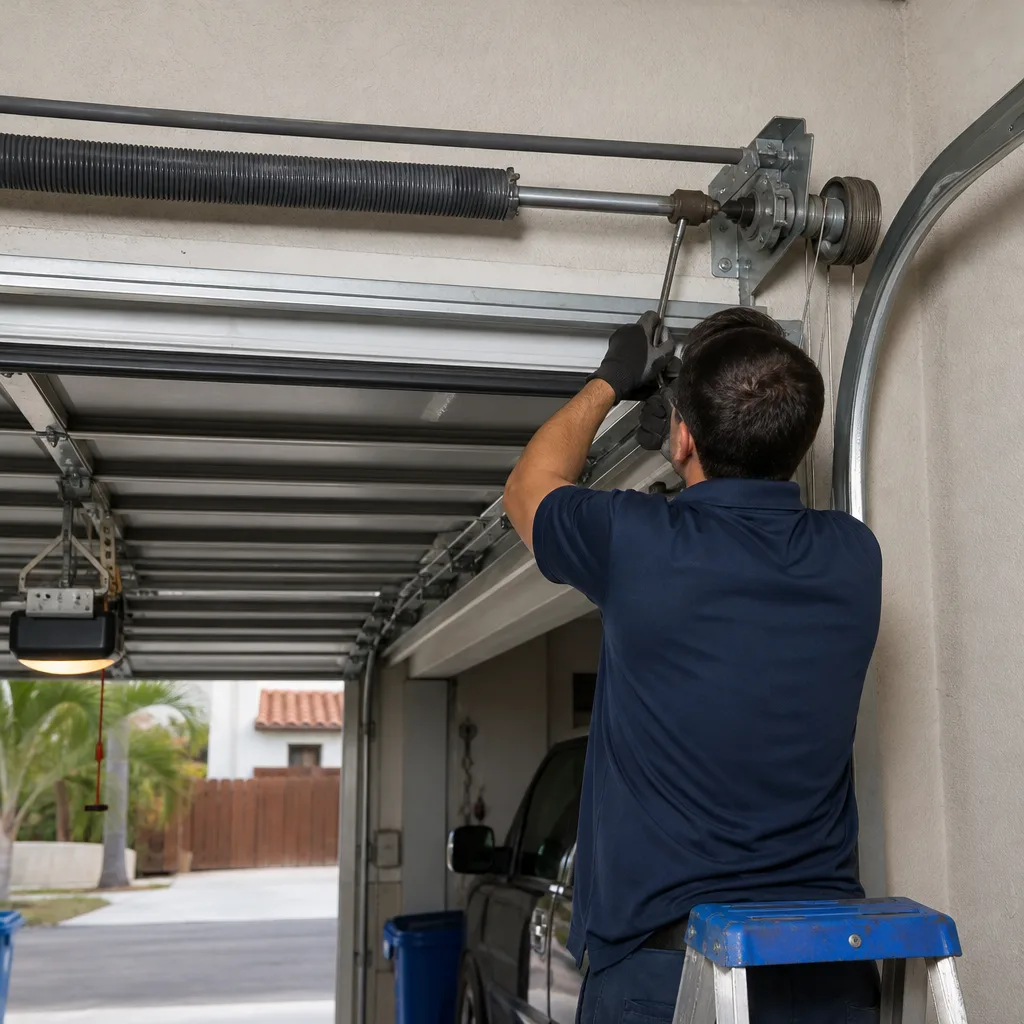
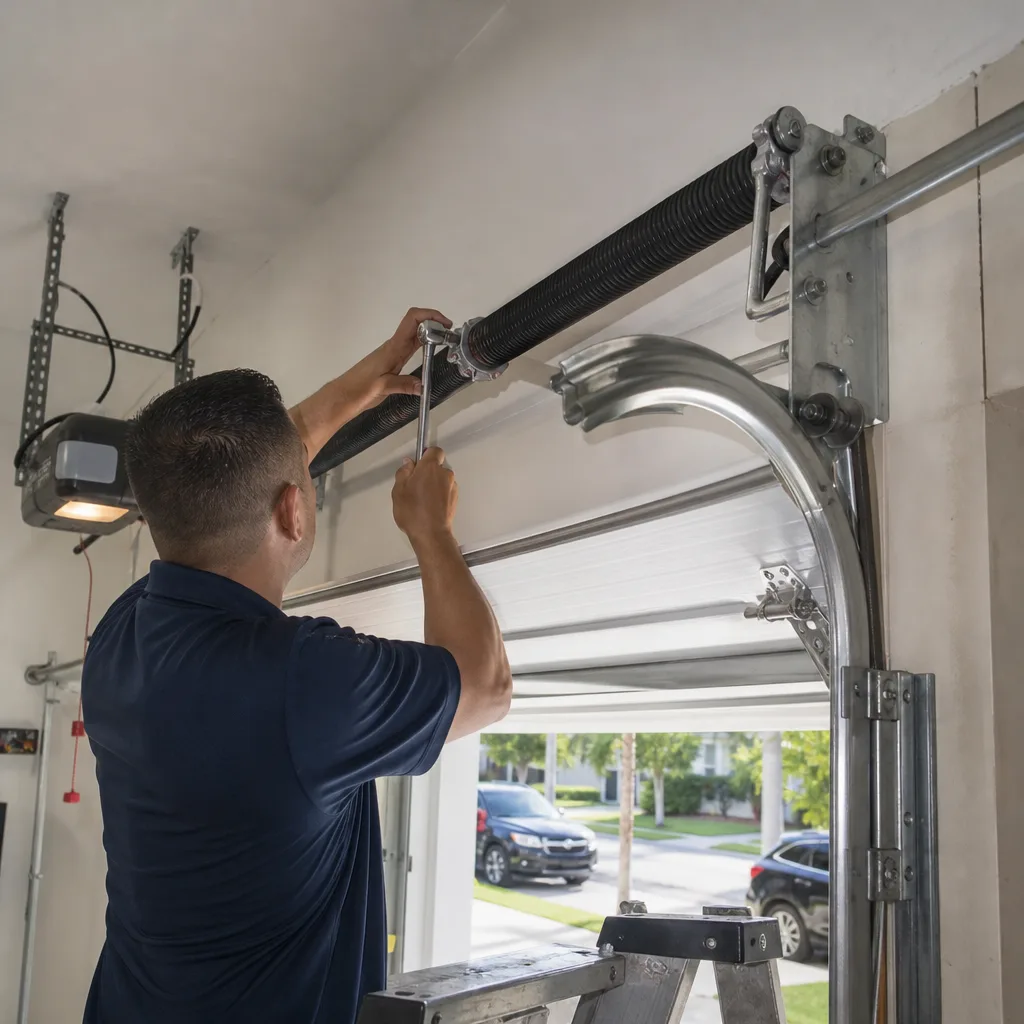
- Any spring work: adjustment, repair, or replacement. Torsion springs carry the full weight of a raised door. Extension springs can snap and take out anything in their path.
- Cable replacement or re-spooling. Cables work in tandem with springs and are under the same tension.
- Track realignment. A track that’s shifted means the door’s travel path is off, and forcing it can derail the door entirely.
- Opener motor replacement or logic board issues. Modern openers from LiftMaster and Chamberlain have diagnostic codes; guessing at them wastes time and can damage the unit.
For everything in the second list, call a garage door specialist. Garage doors are all we do at Top Notch Garage Door Repair home, and a fast diagnosis beats a long guessing game every time.
See the difference
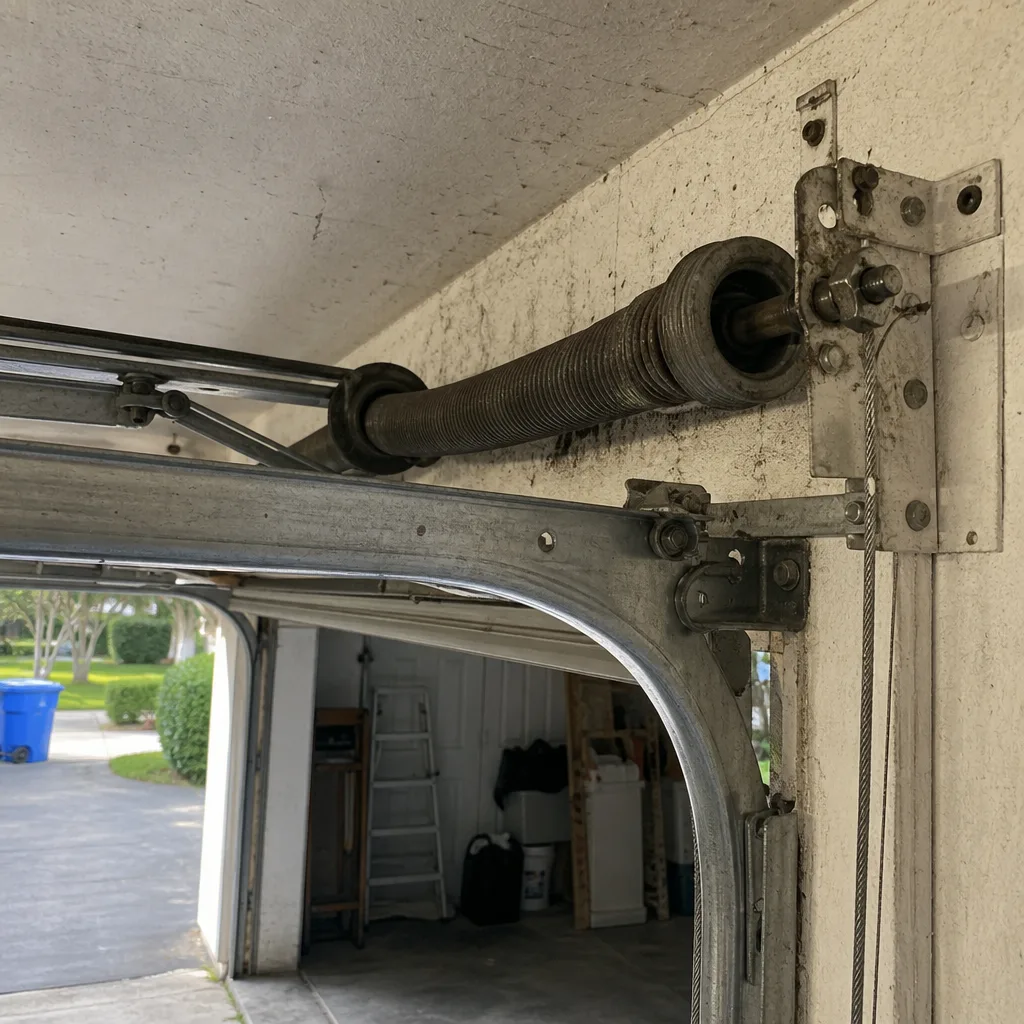 Before
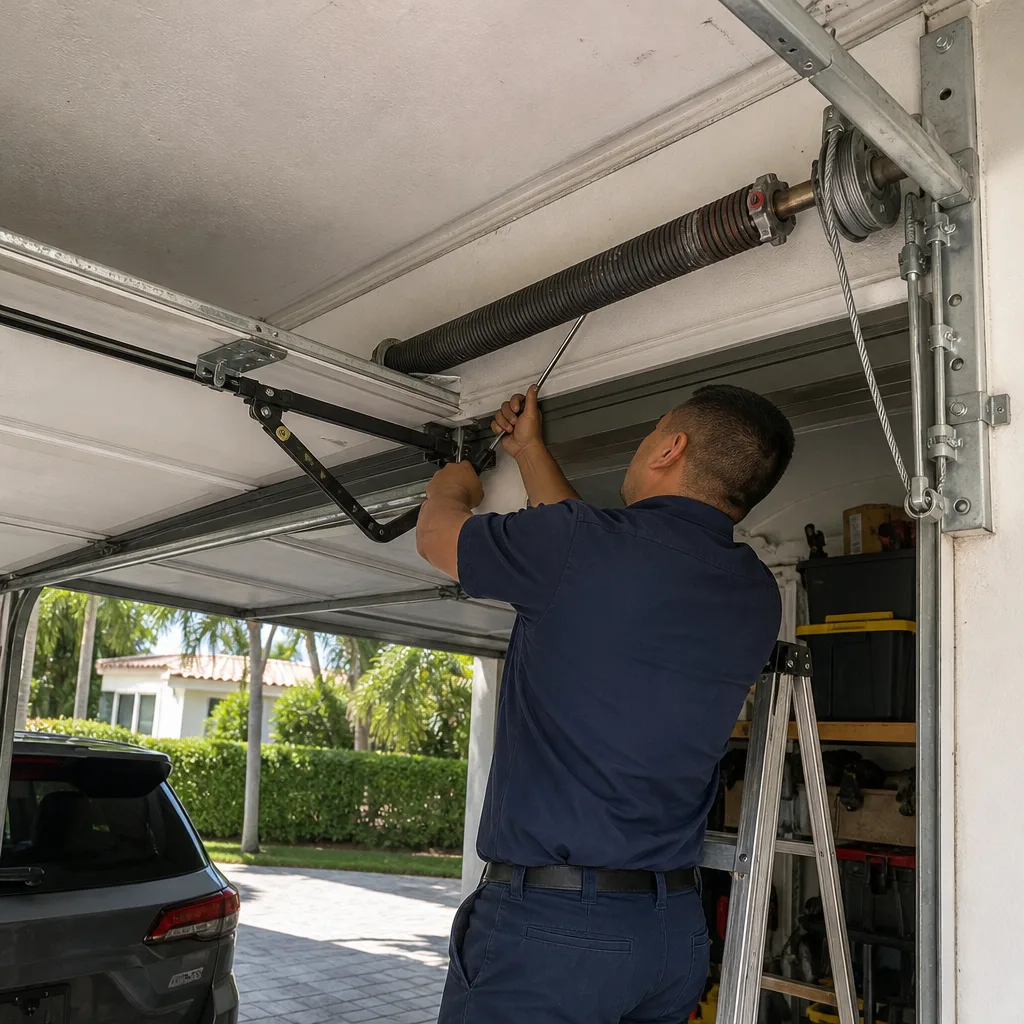 After
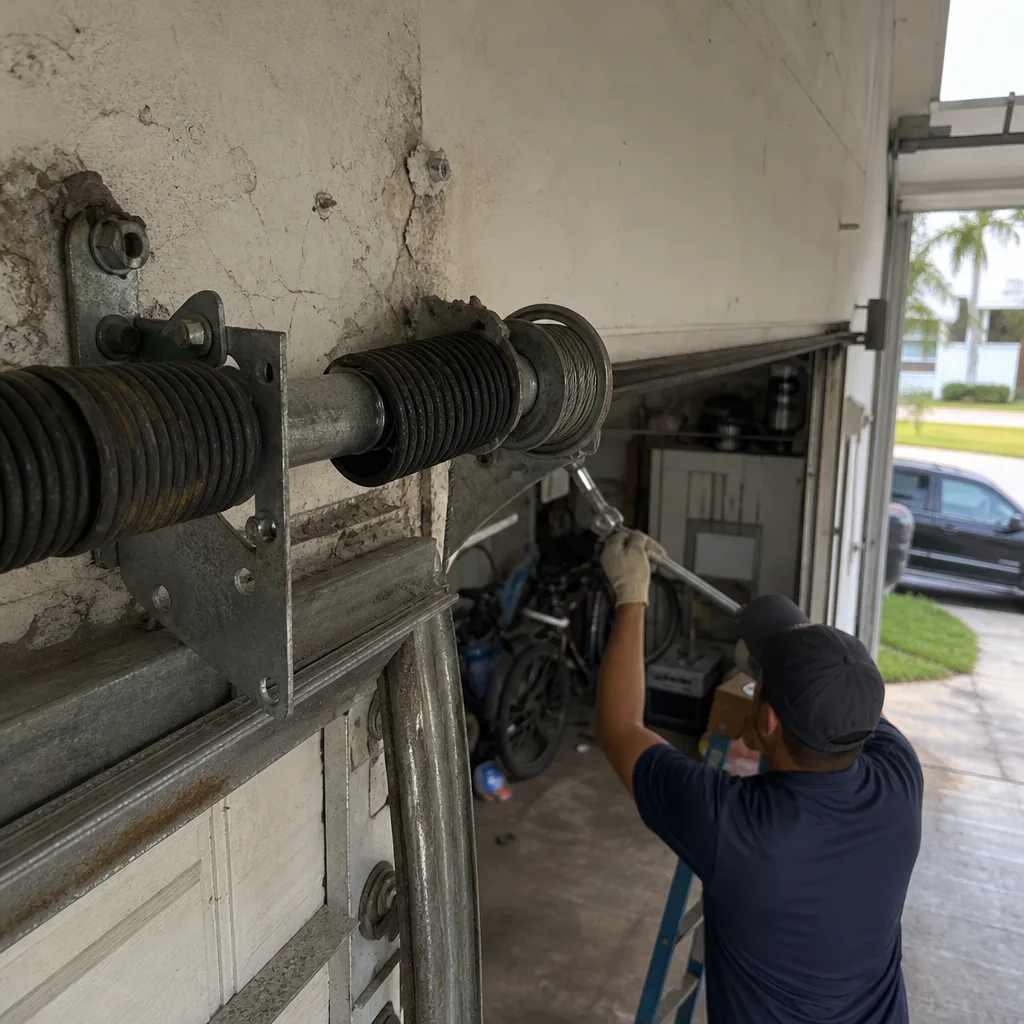 Before
 After
 Before
 After
A Seasonal Maintenance Calendar for Miami Beach
If all of the above feels like a lot to track, here’s the simplified calendar. Put these five tasks in your phone. They take less than two hours combined over the course of a year:
Monthly (10 minutes)
- Visual spring inspection: look for flaking, pitting, or gaps in torsion spring coils.
- Cable check: scan for fraying, fuzziness, or rust dust around the drums.
- Bottom seal glance: look for gaps, cracks, or flattening.
Quarterly (30 minutes)
- Lubricate hinges, rollers, and tracks with PTFE-based or white lithium product.
- Run the balance test: disconnect the opener, lift halfway, confirm it holds.
- Clean the tracks with a dry cloth; remove sand and salt residue.
Every May, Before Hurricane Season (1 hour)
- Full six-step hurricane-season checklist from above.
- Test opener battery backup if equipped.
- Confirm all track bolts and anchor plates are tight.
Annually
- Professional spring tension test and full hardware inspection.
- Reseal or touch up paint on any exposed metal or wood.
- Reassess bottom seal replacement needs.
This is the rhythm that works in Miami Beach. Less than an hour a month, and it prevents the majority of emergency calls we see every summer.
Common Mistakes to Avoid
- Using a national maintenance checklist as-is. A guide written for a dry climate won’t account for salt corrosion rates, humidity swelling, or hurricane-season hardware requirements. The frequencies and inspection points in this guide exist because the standard advice is insufficient here.
- Spraying lubricant on rusty parts without cleaning first. Lubricant over existing rust traps the rust against the metal. Clean the surface first, then lubricate. Otherwise you’re sealing in the problem.
- Ignoring a noisy door because it still opens. Grinding, squeaking, or popping sounds are the earliest warning signs of wear. In Miami Beach, a hinge that squeaks in April can seize by August if left untouched.
- Treating the bottom seal as optional. It’s not cosmetic. A failed seal lets storm water into the garage, which rusts the bottom brackets, soaks any stored cardboard or electronics, and invites mold in a humid climate.
- Reusing old hardware with a new door. If you’re getting a full door replacement through garage door installation in Miami Beach, the old springs, cables, and track are matched to the old door. Reusing them on a new door means mismatched tension and premature failure.
- Testing the door the day before a hurricane. If you wait until a storm is in the forecast to inspect, you’re too late for any repair that requires parts or professional service. The May pre-season pass exists for a reason.
- Forgetting the manual release test entirely. Most homeowners have never pulled the red cord. If you don’t know how the manual release feels, you’ll discover it in the dark during a power outage, which is not when you want to learn.
When to Call a Professional
Some maintenance findings require a trained eye and the right tools. Call a technician when you see a gap in a torsion spring coil, fraying on any cable, a door that won’t stay balanced halfway up, or a track that’s visibly out of alignment. These are not DIY fixes, and attempting them without the right experience and equipment is genuinely dangerous. A spring under tension stores enough energy to seriously injure someone if it releases unexpectedly. For everything else on the spring, cable, and track list, call a professional who works on garage doors every day, not as a side service. Top Notch Garage Door Repair offers free estimates in Miami Beach. Call (855) 754-6010 to schedule an inspection.
Frequently Asked Questions
Plan on a monthly visual inspection, quarterly lubrication and track cleaning, an annual professional tension test, and a thorough pre-hurricane-season pass every May. That’s more frequent than national recommendations, and it matches what Miami Beach’s salt air and humidity actually do to metal hardware.
The first visible sign is usually orange-brown rust dust around the cable drums, followed by white chalky corrosion on hinges. If you see either, the protective coating has already failed, and the underlying metal is degrading. Call (855) 754-6010 for an inspection before it progresses further.
Yes, with the right product. Use a dry PTFE spray or white lithium, and never the standard blue-can WD-40, which strips rust protection. Apply lightly, wipe away excess, and never touch or adjust a spring under tension. The lubrication is safe; the adjustment is not.
Yes. The garage door is the largest opening in your home, and failure during a storm can cause structural damage far beyond the door itself. Minimum pre-season tasks: test the manual release, inspect the bottom seal, check wind-load hardware, verify spring balance, and test any battery backup on your opener.
Partially correct. Aluminum doesn’t rust, but it does corrode, especially at contact points with steel fasteners. You’ll see white powder around hinges and brackets, which means galvanic corrosion is active. Aluminum frames also flex more than steel and can crack at welded joints over time. It’s lower maintenance than steel, but not maintenance-free.
If your springs are seven years old or older, or if you can see visible pitting, flaking, or a gap in the coil, yes, proactive replacement is the right call. A broken torsion spring strands you outside or traps your car inside, and in the middle of Miami Beach summer, a same-day repair isn’t always available. Replacement is cheaper and safer than an emergency. Call (855) 754-6010 for a spring life estimate on your specific door.
Heat thins lubricant and causes metal surfaces to expand, which brings moving parts into tighter contact. In Miami Beach, the added humidity accelerates both effects. A door that’s silent in January and noisy in August needs fresh lubricant and possibly new rollers. If re-lubricating doesn’t quiet it, the rollers are worn.
A strut is a long metal reinforcement bar that runs horizontally across the inside of each door panel. It stiffens the panel against hurricane-force winds. Check that all struts are firmly attached with no gaps between the strut and the panel, no missing screws, and no bends. If a strut has come loose, the wind-load rating of your door is compromised.
The Bottom Line
Garage doors in Miami Beach don’t fail by accident. They fail because salt air was allowed to work on unprotected metal for months, because the bottom seal degraded and nobody noticed, because a spring lost tension slowly and the balance test was never done. The maintenance calendar in this guide addresses exactly those failure points, on the schedule this climate demands. Ten minutes a month. Thirty minutes a quarter. One focused hour in May. That’s the entire cost of preventing most emergency calls, and it’s dramatically cheaper than any repair you’ll face after a failure. If something on your inspection turns up a problem that’s beyond the visual, or if you’d rather have a professional do the seasonal pass, call (855) 754-6010 for a free estimate. We’ll give you the right fix the first time, on the brand you already have. Repair when possible, replace when necessary, and get your door back up and running.
Written by the team at Top Notch Garage Door Repair, serving Miami Beach since 2014. Explore more guides & resources on our blog.